Author: Micky Midha

  • Mock Review Playbook

    Mock Review Playbook

    Introduction

    A mock exam often feels like a judgment on your preparation. You look at the total score, compare it with your expectations, and the anxiety sets in. The truth is different. A mock exam is a diagnostic. It shows how you think under pressure. It shows what you truly understand and what needs reinforcement. When you review a mock the right way, the score becomes the least important part of the process.

    Unfortunately, many CFA candidates rush from one mock to the next without a structured review. They hope repetition will lift their scores, yet the same errors appear again. This results in stress, overconfidence in some areas, and blind spots in others.

    This playbook gives you a practical routine to review any CFA Level 1 mock. You will learn how to identify patterns, classify your errors, and create a targeted revision plan that actually sticks. Think of this as an operating manual for mock exams. Follow it consistently and you will feel more confident, more organised, and more prepared for exam day.


    Mindset First: Score Last, Learning First

    When you finish a mock, the instinct is to check the total. Resist that urge. Your score is only a snapshot of one attempt. It does not say anything about your potential. Note it once for reference, then put it aside.

    Your real goal is to understand your decisions. Why did you select a particular option. What were you thinking. Where did the reasoning break. What steps were rushed. When you review your thinking rather than only the outcome, you develop exam discipline. This is what separates candidates who improve from candidates who stagnate.

    Tell yourself this before every mock review:
    The score comes last. The learning comes first.


    Phase 1. Set Up a Proper Review Session

    Treat your review with the same respect as the mock.

    Create a quiet window

    Give yourself two to three hours on the same day or the next morning. Reviewing while the thought process is still fresh helps you understand what you attempted to do, not only what you got right or wrong.

    Gather your tools

    You will need:

    • Your marked mock exam.
    • Official explanations.
    • A simple tracker. Notebook or spreadsheet.
    • Your formula sheet or summary notes.

    Keep everything in one place. A clean setup prevents distractions.

    Define what you want to achieve

    Every review should produce three outputs.

    1. A topic heat map.
    2. An error classification table.
    3. A seven day revision plan.

    When you review with a clear purpose, you stay focused and finish with actions instead of confusion.


    Phase 2. Build a Topic Heat Map

    Before you zoom in on individual questions, start with a top down picture.

    Tag your mistakes

    Go through your mock and label every wrong question by topic.
    FRA. Inventory.
    Fixed Income. Term structure.
    Quant. Sampling.
    Equity. Dividend discounts.

    Be specific. This helps you find patterns.

    Add a short reason tag

    Next to each wrong question, add a short code.

    • Concept gap.
    • Calculation slip.
    • Misread.
    • Time pressure.
    • Guess.
    • Procedure error.

    Do not overthink. Just label what feels correct.

    Summarise the pattern

    Now group your accuracy by sections. Ethics. Quant. Economics. FRA. Equity. Fixed Income. Corporate Issuers. Derivatives. Alternatives. Portfolio Management.

    Create a table with two numbers for each section.
    Total attempted.
    Total correct.

    You will often notice that two or three areas account for most of your lost marks. These are your immediate targets for the coming week.

    This heat map prevents random studying and keeps your focus sharp.


    Phase 3. Build an Error Taxonomy That Works

    Not all mistakes need the same fix. Your review becomes powerful when you understand the type of error you made.

    Common mistake types and how to fix them

    Concept gap

    You do not know or do not recall the underlying idea.
    Fix: Reread only the relevant section. Keep it short. Then solve ten to fifteen targeted questions.

    Framework confusion

    You know the pieces but cannot connect them.
    Fix: Rebuild the structure. Write a decision tree or short summary in your own words.

    Procedure error

    You understood the concept but executed steps incorrectly.
    Fix: Create a three to five step checklist and rehearse it before new questions.

    Formula slip

    Idea is right. Calculation is wrong.
    Fix: Annotate the formula with units and common traps. Then practise slowly with unit checks.

    Reading misinterpretation

    You missed a keyword or detail.
    Fix: Train yourself to underline qualifiers. Annual, nominal, pre tax, post tax, before adjustments, after adjustments.

    Time management miss

    You spent too long on one difficult question.
    Fix: Use strict cutoffs. If you cross ninety seconds without a plan, flag and move on.

    Blind guess

    Either you ran out of time or had not studied the topic.
    Fix: Decide whether it falls within this weeks scope. Not all gaps need immediate fixing.

    Over two or three mocks, you will notice patterns. Maybe you misread often. Maybe formulas. Maybe concept clarity. Your taxonomy directs your revision.


    Phase 4. Deep Dive the Top Three Problem Areas

    Do not try to fix everything. It spreads your attention too thin. Pick the three highest impact areas from your heat map and go deep.

    Step 1. Relearn with purpose

    Focus on the exact node where your understanding failed. If you missed questions on leases, focus on measurement and impact. Do not reread the entire FRA book.

    Step 2. Create a one page note

    Write the rules and relationships in your own words. One page only. If it cannot fit on a single page, it is not distilled enough.

    Step 3. Run a deliberate practice set

    Solve ten to twenty questions on that node. Check your result. If accuracy is below eighty percent, repeat with a new set.

    Step 4. Build a trap list

    Note phrasing, numbers, or patterns that trick you. Every subject has traps. Once you know them, your accuracy jumps.

    This focused cycle saves time and drives retention.


    Phase 5. Post Mock Reinforcement Routine

    Your brain forgets what it does not revisit. Use a simple reinforcement window.

    Within 24 hours

    Redo every question you got wrong without looking at explanations. If you still miss it, mark it in red. This makes the concept memorable.

    Within 3 days

    Attempt ten fresh questions in your weak topics. Keep the sets short.

    Within 7 days

    Take a mixed thirty to forty five minute quiz that includes your trap topics. Aim for eighty percent or higher.

    This rhythm keeps your understanding active and prevents forgetting during the long preparation cycle.


    Smart Strategy for Taking Mocks

    Review matters, but how you take mocks also affects performance.

    Two pass technique

    On the first pass, harvest the clean points. Skip anything that feels long or unclear.
    On the second pass, return to flagged questions and think more deeply.

    This prevents time traps and builds confidence.

    Choose a section order and stick to it

    Some candidates start with Ethics for calm reading. Others start with their strongest section to gain early momentum. Choose what suits your mind and use the same plan for all mocks. Consistency builds rhythm.

    Micro cutoffs

    You have roughly ninety seconds per question on average. Do not exceed that on the first pass. When your timer crosses ninety seconds and you still have no plan, move on.

    Simulate exam conditions

    Use the same calculator. Same water bottle. Same scratchpad style. Same break pattern. Reduce surprises on exam day.


    Turning the Review into a Weekly Plan

    When the review is complete, write a one page plan with three parts.

    Wins

    What went well. What improved. Celebrate small progress.

    Fixes

    Top three issues with a clear remedy.
    Example. FRA. Deferred tax recognition rules. Ten targeted questions on Wednesday.

    Rules for the next mock

    Two behaviour rules you will follow.
    For example. Underline compounding frequency. Move on at ninety seconds.

    Pin this one page plan near your study desk. This keeps you honest and consistent.


    How Many Mocks Should You Take

    There is no magic number. What matters is depth of review, not quantity.
    For most Level 1 candidates, five to seven full mocks with proper review is more than enough.

    If you begin late, do three to four mocks but review every one with precision. Improvement comes from reflection, not repetition.


    Final Takeaway

    A mock exam is not a verdict on your readiness. It is a spotlight that reveals how you think under pressure. The review is where learning happens. Build a heat map. Classify your errors. Fix three areas at a time. Reinforce within a week. Refine your exam behaviour. Repeat.

    Do this consistently and your scores will rise. More importantly, your decision quality will mature. That is what passes the CFA exam.
  • Do I Need a Finance Background for pursuing CFA ?

    Do I Need a Finance Background for pursuing CFA ?

    Introduction

    Every year, thousands of candidates from engineering, economics, mathematics, and even the arts begin their CFA journey. Many share the same concern: Can I do this if I don’t have a finance background?

    It is a fair question. The CFA curriculum looks intimidating at first glance. Terms like “equity valuation,” “portfolio optimization,” or “derivative pricing” can sound foreign to someone outside finance. Yet the truth is simple. A finance degree helps, but it is not a requirement. What matters most is your ability to learn systematically, think analytically, and stay consistent.

    The CFA program is designed for a global audience. It assumes that not every candidate starts with formal finance education. The curriculum builds your knowledge layer by layer, from the basics of money and time value to advanced portfolio management.

    Let’s unpack what that really means in practice.


    Understanding the CFA Curriculum

    The CFA Institute structures the curriculum around three progressive levels. Each level deepens your understanding but begins with clear, defined fundamentals.

    Level I – Building the Foundation

    Level I introduces you to the language of finance. You learn how markets work, what financial statements show, and how analysts interpret them.

    Key subjects include:

    • Quantitative Methods: Basic statistics, probability, and time value of money.
    • Financial Reporting and Analysis: Understanding income statements, balance sheets, and cash flow.
    • Ethics and Professional Standards: The backbone of the CFA program.
    • Economics and Corporate Finance: Core principles applied to investment decisions.

    A non-finance candidate can learn these with discipline and the right resources. Nothing here requires prior accounting or trading experience. You just need to approach each topic as a structured problem, not as jargon to memorize.

    Level II and III – Application and Integration

    Level II moves into valuation, asset classes, and analytical techniques. Level III focuses on portfolio management and client strategies.

    By the time you reach these levels, you will already have enough context to connect the dots. The progression feels natural if your foundations are clear. This design is intentional — the CFA Institute wants candidates from diverse academic backgrounds to succeed.


    The Real Prerequisites: Curiosity and Consistency

    What truly predicts success is not a finance degree. It is the willingness to learn consistently over time.

    • Curiosity helps you question why a concept matters. When you study risk-adjusted returns, do not stop at the formula. Ask what it means in a real portfolio.
    • Consistency keeps you on track. The CFA program rewards steady progress more than bursts of last-minute effort.

    Most successful candidates treat CFA preparation like a long-term project. They plan 250–300 study hours per level, review regularly, and practice actively. This discipline levels the field between finance and non-finance backgrounds.


    What to Expect If You Are Not from Finance

    You will likely face three early challenges.

    1. Unfamiliar Terminology

    Words like “yield curve,” “accruals,” or “beta” may appear confusing. Do not rush through them. Build a quick glossary as you study. Once you use these terms in examples and practice questions, they will stick naturally.

    2. Accounting Concepts

    Many candidates find accounting to be the toughest subject initially. Focus on the logic rather than the format. Learn how transactions flow through financial statements. If possible, watch short explainer videos or attend structured sessions that connect accounting to business reality.

    3. Quantitative Methods

    The math is not advanced, but it requires attention to detail. You will deal with statistics, discounting, and probability. Use spreadsheets to practice calculations and visualise what formulas do. Once you see how the numbers behave, the fear of formulas fades.


    How to Bridge the Knowledge Gap

    Here are some practical steps to build comfort quickly.

    1. Start Early with the Basics
      Spend the first few weeks understanding financial statements and time value of money. These two topics are used everywhere in the CFA curriculum.
    2. Use the Right Study Order
      If you are a beginner, do not start with Derivatives or Fixed Income. Begin with Ethics, Quantitative Methods, and Financial Reporting. That sequence builds a strong foundation.
    3. Focus on Understanding, Not Memorization
      Ask “why” behind every formula. For instance, why does compounding matter? Why is discount rate linked to risk? This habit converts facts into intuition.
    4. Join a Study Group or Mentorship Program
      Interaction speeds up learning. When you explain a topic to others, you identify your own gaps. MidhaFin’s study groups and doubt-clearing sessions are excellent for this.
    5. Regularly Practice Questions
      Conceptual clarity grows through application. After every topic, solve 15-20 questions. Review explanations carefully. The CFA exam rewards reasoning, not memorized answers.
    6. Link Finance to Real-World News
      Read market summaries or company reports occasionally. You will begin to connect theory to practice, which is the essence of becoming a finance professional.

    How Candidates from Non-Finance Backgrounds Perform

    Interestingly, the CFA Institute’s own data shows that many successful candidates come from non-finance backgrounds, particularly engineering and economics.

    Why? Because analytical thinking and problem-solving matter more than prior subject exposure. Engineers, mathematicians, and statisticians often find the quantitative parts intuitive. Those from commerce or business degrees may grasp accounting faster. Each background has strengths.

    The CFA program equalises the rest. Over time, everyone builds a balanced understanding across ethics, economics, analysis, and portfolio management.


    The Value of a Non-Finance Perspective

    There is also an advantage to entering CFA without formal finance education. You approach topics with fresh logic instead of assumptions.

    For instance:

    • An engineer studying portfolio optimization sees it as a systems problem of risk and return.
    • An economist views market cycles through data relationships.
    • A computer science graduate may see quantitative finance as an extension of algorithms.

    These diverse approaches enrich your understanding. Modern finance values multidisciplinary thinking, which includes the ability to apply logic, statistics, and technology together.


    What You Gain from the CFA Journey

    Regardless of your background, the CFA program builds the same core skill set:

    • Ethical and professional reasoning.
    • Financial analysis and interpretation.
    • Understanding of global investment markets.
    • Ability to communicate financial insight clearly.

    These are transferable skills. Whether you become a portfolio analyst, risk manager, consultant, or entrepreneur, this foundation adds credibility and structure to your decision-making.


    Final Takeaway

    You do not need a finance background to pursue the CFA charter. You need persistence, curiosity, and a clear study plan.

    Think of the CFA journey as a bridge from where you are to where you want to be. The early steps may feel steep, but every topic builds on the last. Within months, you start thinking like an analyst. The transformation from learning terms to applying logic makes the CFA experience truly rewarding.

    Stay patient, stay structured, and stay curious. The finance background can wait. The mindset cannot.

  • Making Sense of CFA Level 1 Pre-Readings: What You Should Actually Do

    Making Sense of CFA Level 1 Pre-Readings: What You Should Actually Do

    Preparing for the CFA Level 1 exam often comes with a question that confuses many students:

    Should you study the pre-readings that appear before the main curriculum? 

    These short readings are meant to introduce key ideas in Economics, Quantitative Methods, and Financial Statement Analysis.

    Let us understand what they really mean, why they exist, and how to deal with them in a practical way.


    Understanding the Purpose of Pre-Readings

    The CFA Institute has recently reorganized the Level 1 syllabus to make it more efficient. Some of the older introductory lessons have been separated from the main modules and placed in a section called pre-readings.

    Their goal is simple: to prepare candidates with the basic knowledge required before starting the core material.

    The pre-readings include the following::

    • Quantitative Methods: Basic statistics, probability, and numerical tools
    • Economics: Key ideas in microeconomics and macroeconomics
    • Financial Statement Analysis: Structure and meaning of income statements, balance sheets, and cash flow statements

    These topics act as the entry gate to the larger curriculum. But the real question is:  

    Should you spend time reading them all?


    Are Pre-Readings Worth Your Time?

    The CFA Institute suggests that most candidates are already familiar with the material. That might be true for some, but not for everyone.

    If you have been away from academics for a few years, or if your degree was not in finance, some of these ideas might not feel as fresh. Going straight into the main syllabus without revisiting them can make the learning curve steeper.

    So, even if the pre-readings are not directly tested, they still influence how well you understand what follows. Think of them as the foundation on which the entire Level 1 syllabus stands.


    How to Approach Them Without Wasting Time

    Not every candidate needs to go through every page. What works better is a filtered, topic-by-topic review.

    Here is a structured plan:

    1. Get a quick overview.
      Read the chapter introductions and sub-headings to understand what each section covers.
    2. Mark your comfort zones.
      Identify areas that look familiar. For example, if you have used accounting statements regularly, you might not need to study all of FSA in detail.
    3. Focus on weak points.
      Spend time only on parts that seem unfamiliar or unclear. This selective study method helps you save time while reinforcing areas that matter.

    If you have ample time before the exam, you can dedicate around two weeks per section. If you are on a tighter timeline, a few focused study sessions per area will still be effective.


    Key Areas That Deserve Extra Attention

    Some topics in the pre-readings create the base for many later chapters. You can use the following checklist to stay focused:

    • Quantitative Methods: Concentrate on descriptive statistics, measures of dispersion, and probability. These ideas return again in regression, correlation, and risk analysis.
    • Economics: Refresh your understanding of demand and supply, market types, inflation, and economic growth indicators.
    • Financial Statement Analysis: Ensure you can interpret how the three financial statements connect. Knowing how numbers move between income, cash flow, and balance sheets saves time later.

    The MidhaFin View: Study Smart, Not Twice

    At MidhaFin, we strongly believe that you do not need to study everything twice. If a topic covered in the pre-readings appears again later in the curriculum, and is explained there in full, then you can safely cover it once, in detail, during the main study.

    This approach forms the base of how we design our study material and video lessons. Our goal is not to overload students with repetitive theory but to guide them through a logical sequence of learning.

    For example, if Financial Ratios are introduced briefly in the pre-readings and then taught extensively in the FSA section, it is more efficient to learn them properly when you reach that chapter. By doing so, you spend your effort where it adds the most value instead of revisiting the same ideas multiple times.

    This mindset not only saves time but also builds stronger conceptual links between topics. In CFA preparation, efficiency is just as important as effort.


    Why a Strong Foundation Still Matters

    Even though pre-readings are not tested directly, they shape how smoothly you move through the rest of the material. Students who skip them entirely often need to pause later to fill in missing basics, which breaks study flow.

    Instead, treat them as a warm-up round. Review them quickly, fill knowledge gaps, and then move to the core chapters with confidence. Remember that CFA Level 1 is not about memorizing every line; it is about understanding how financial concepts connect.


    A Balanced Strategy for Success

    Here is a simple rule:

    • If a concept is completely new to you, study it now.
    • If you already know it, just refresh it briefly.
    • If it will be covered again in depth later, combine the learning and handle it once.

    This three-step thinking helps you stay efficient without missing key knowledge.

    In our MidhaFin learning framework, this balance is built into the study plan. Every topic connects to the next in a natural order so that you keep moving forward without confusion or overlap.


    Closing Thoughts

    Pre-readings might look like optional reading material, but they play an important role in shaping your confidence for the CFA Level 1 exam. They ensure that when you reach complex parts of the syllabus, you do not get stuck on concepts that should have been clear earlier.

    Treat them as the foundation, not as an extra burden. Study them with purpose, connect them with your main lessons, and always think about how each topic fits into the bigger picture of finance and investment analysis.

  • CFA Scholarships: Complete Guide for CFA Candidates

    CFA Scholarships: Complete Guide for CFA Candidates

    If the cost of the CFA Program feels heavy, scholarships from CFA Institute can make it easier to begin your journey. This guide covers all available scholarships, how they work, who is eligible, and what you must know before you apply.


    What Are CFA Scholarships

    CFA Institute offers scholarships to make the CFA Program more accessible. Each scholarship waives the one-time enrollment fee and provides a discounted registration fee for an exam.

    Every award helps qualified individuals start or continue their CFA studies while maintaining the same high standards of ethics, education, and professionalism.


    Types of CFA Scholarships

    Let us look at the main scholarships currently offered by CFA Institute.
    (For official details, visit CFA Institute Scholarships.)

    1. Access Scholarship

    • For individuals who may not be able to afford the program fees.
    • You must not be currently registered for a CFA exam or waiting for results.
    • Covers one exam cycle only.
    • If awarded, you receive a waived enrollment fee and a reduced registration fee.
    • If you do not use the scholarship before it expires, you will not be eligible for future awards.

    Learn more: Access Scholarship


    2. Student Scholarship

    • For students currently enrolled at a CFA-affiliated university.
    • You must not be registered for any upcoming exam or waiting for your result.
    • You apply through your university’s CFA coordinator.
    • It also includes a waived enrollment fee and a discounted registration fee.

    Learn more: Student Scholarship


    3. Professor Scholarship

    • For full-time professors or qualified administrators who teach a minimum number of credit hours each term.
    • You must not be currently registered for a CFA exam or waiting for results.
    • It allows academic professionals to experience and share the CFA Program with their students.

    Learn more: Professor Scholarship


    4. Regulator Scholarship

    • For employees of central banks, financial regulators, stock exchanges, or government agencies that oversee the financial markets.
    • You must not be registered for an exam or awaiting results.
    • Includes the same fee benefits as other scholarships.

    Learn more: Regulator Scholarship


    General Rules and FAQs

    CFA Institute outlines clear rules for all scholarships. Here are the key points:

    • You cannot apply for more than one scholarship at a time.
    • You must wait until you receive an award decision before applying again.
    • If you are awarded a scholarship, you must register, schedule, and sit for the exam before applying for another.
    • If you fail to use your scholarship before it expires, you will not be eligible for future ones.
    • The discounted fee appears on the final registration page before payment.
    • You can apply multiple times across cycles as there is no limit on the number of attempts.

    For complete FAQs, refer to Scholarship FAQs on CFA Institute.


    How to Apply for a Scholarship

    Here is a simple plan you can follow.

    1. Choose the right scholarship
      Check which category fits your profile: Access, Student, Professor, or Regulator.
    2. Read eligibility rules carefully
      Go through the CFA Institute’s individual scholarship page to confirm that you qualify.
    3. Apply through the CFA Institute website
      Create or log in to your CFA Institute account and complete the online application.
    4. Submit required documents
      Some scholarships need proof of employment, university enrollment, or financial status.
    5. Wait for your result
      The outcome is sent to your registered email address. If awarded, you can use the discount for your next registration.

    Important Dates and Deadlines

    Each scholarship has its own application window.
    CFA Institute updates these timelines regularly, so you should check the official CFA Scholarship Dates page before submitting.

    We recommend marking your calendar at least a month before the deadline so that you have time to prepare your essay or supporting documents.


    How to Write a Strong Scholarship Application

    Your essay or statement should reflect your motivation for pursuing the CFA charter. Avoid generic lines like “I want to learn more about finance.” Instead, share your personal story or the reason you chose the CFA path.

    Keep it short, honest, and focused on how the CFA Program connects with your goals.
    For a detailed structure, visit our internal guide: How to Write a CFA Scholarship Essay.


    Common Mistakes to Avoid

    • Registering for an exam before applying for a scholarship.
    • Submitting incomplete information or missing documents.
    • Reusing old essays without updating details.
    • Waiting until the last day to apply.

    Small errors can disqualify your application, so always double-check your submission before hitting submit.


    Quick Recap

    • Four key scholarships: Access, Student, Professor, Regulator.
    • All waive the enrollment fee and discount the exam registration fee.
    • You cannot hold multiple scholarships at once.
    • Apply directly on the CFA Institute website.
    • Watch your email for decisions and use your scholarship before it expires.

    Conclusion

    Scholarships are one of the best ways to start your CFA journey with less financial pressure. Read the official pages carefully, prepare your application early, and stay honest in your essay. It is worth the effort.

    For more free CFA resources, visit cfa.midhafin.com.

  • How to Write a Winning CFA Scholarship Essay: A Step-by-Step Guide for Finance Aspirants

    How to Write a Winning CFA Scholarship Essay: A Step-by-Step Guide for Finance Aspirants

    Earning the CFA Charter is a serious goal. It opens doors in investment management, financial analysis, and research. It also proves that you have the discipline and knowledge to succeed in one of the most respected areas of finance. The only challenge is that it is both demanding and expensive.

    For many candidates, the CFA Access or Student Scholarship is a real opportunity. It reduces the exam fee to a much lower amount and gives motivated applicants a fair chance to move forward in their CFA journey without being stopped by financial limits.

    But the scholarship is not guaranteed. The Access Scholarship is partly based on a lottery system. This means that even with a strong essay, there is still an element of luck involved. Still, your essay matters a lot. It is your chance to show who you are, what you hope to achieve, and why you are serious about earning the CFA Charter.

    This guide will help you write an essay that feels real, organized, and confident, giving you the best possible chance once your application is in the selection pool.


    1. Start with Your Story and Long-Term Goal

    Every strong essay begins with your story. Think about when you first became interested in finance. Maybe you grew up around people who ran a business, or maybe you followed market news and wanted to understand how investments work. You do not need to make it sound dramatic or emotional. A simple, honest story that shows where your interest started is enough.

    Then, connect that story to your long-term career goal.

    Example:

    “My interest in finance started during my undergraduate studies when I learned how markets influence the overall economy. I became curious about how investment decisions can shape companies, communities, and industries. My long-term goal is to work in financial research and portfolio management, helping clients make informed and responsible investment decisions.”

    This introduction gives your essay direction. It tells the committee where your motivation comes from and what you hope to achieve.


    2. Show What You Have Done So Far

    Once you explain your interest, show how you have worked toward that goal. The committee wants to see that you have put effort into building your foundation.

    Talk about your degree, work experience, or any academic projects related to finance. Mention internships, online courses, or clubs that helped you learn more about investment or financial analysis. This shows that your interest is backed by real action.

    Example:

    “To strengthen my knowledge, I earned a degree in economics and completed courses in valuation and portfolio theory. During my final year, I joined my university’s investment club, where I worked with a team to analyze real companies for mock portfolios. These experiences helped me develop a stronger understanding of markets and confirmed that I wanted to build a career in finance.”

    This part of your essay gives credibility. It shows that you have taken your goals seriously and are not just starting from curiosity.


    3. Explain Why the CFA Program Fits Your Path

    Now that you have shown your progress, explain why the CFA Program is the right next step. Avoid copying phrases from the CFA website. Instead, describe how the program connects to your specific goals.

    You could say something like:

    “The CFA Program combines technical knowledge with ethical responsibility, which I believe is essential in today’s financial world. I want to strengthen my analytical and decision-making skills while following a strong professional code of ethics. Because the CFA Charter is globally recognized, it also offers opportunities to grow in an international setting, which is important for the kind of career I want to build.”

    This section helps the committee see that you understand the program’s value and that it fits naturally into your professional journey.


    4. State Your Reason for Applying for the Scholarship

    This part should be short and clear. You do not need to go into personal hardship or emotional detail. The goal is to show that financial help would make a meaningful difference without making it the center of your essay.

    Example:

    “Covering the full exam fee is a challenge at this stage of my career. Receiving the scholarship would allow me to focus fully on my preparation and continue working toward my goal of earning the CFA Charter without financial strain.”

    Keep it simple and factual. It shows that you understand your circumstances and that you are ready to make the most of the opportunity.


    5. Show Your Commitment and How You Will Contribute

    The CFA Institute values candidates who want to make a positive impact, not just advance their own careers. End your essay by explaining how you plan to use your CFA knowledge to help others or improve the profession.

    Example:

    After completing the CFA Program, I want to share what I learn with students and early-career professionals who are interested in finance. I also plan to take part in financial literacy programs that help individuals understand investing and manage money responsibly. In the long run, I hope to work on projects that promote ethical investment and transparency in corporate governance.

    This ending leaves a strong impression because it shows that your goals are not just personal. You want to make a difference.


    6. Understand That Luck Plays a Role

    It is important to stay realistic. The CFA Access Scholarship process includes a random selection element. That means even a great essay might not guarantee success. But the essay is still the one part you can control. It reflects your professionalism, sincerity, and preparation.

    You can think of it like investing. You cannot control the market, but you can control your research, your analysis, and your discipline. The same principle applies here. Luck decides the outcome, but effort increases your chances.

    If you do not receive the scholarship the first time, do not give up. Many people apply again and succeed on their second attempt. Treat each application as practice and keep improving your essay.


    7. Simple Tips That Make a Big Difference

    Before you submit your essay, keep these practical points in mind:

    • Keep your essay between 400 and 600 words, or slightly more if allowed.
    • Write clearly. Avoid unnecessary financial jargon or complex vocabulary.
    • Use examples that show your experiences instead of making general statements.
    • Read your essay out loud to check if it sounds natural.
    • Proofread carefully for grammar and spelling mistakes.
    • Ask someone you trust, such as a mentor or colleague, to review it.
    • Stay honest. The committee can tell when someone writes sincerely.

    These details may sound small, but they make your essay stronger and more authentic.


    8. Final Thoughts

    A CFA scholarship essay is more than a request for financial help. It is your chance to show that you understand what the CFA Program stands for and that you are ready to live up to its standards.

    You cannot control luck, but you can control how well you prepare and how clearly you present your goals. A strong essay shows self-awareness, discipline, and integrity – the same qualities that define successful CFA Charterholders.

    Take your time to think about your journey and what drives you. Write with clarity and confidence. Even if the result depends partly on chance, your essay will reflect your effort and determination to earn a place in the CFA community.

  • How Much Time Do You Really Need to Prepare for CFA Level 1?

    How Much Time Do You Really Need to Prepare for CFA Level 1?

    If you are starting your CFA Level 1 journey, one of the first questions you will ask is —
    “How many hours do I actually need to prepare?”

    You might have seen people on forums quoting numbers like 250 to 300 hours, saying it is enough to clear Level 1.

    While that might be true for some, the reality is more layered. The right amount of time truly depends on:

    Your background – Are you from finance, accounting, or completely new to these subjects?
    Your goals – Are you aiming to simply scrape through or genuinely master the concepts?
    Your seriousness & discipline – Are you consistent, or will you squeeze studies only on weekends?


    🏗️ The Two Types of CFA Aspirants

    🎯 1. The “Just to Pass” Group

    This group usually targets 250 to 300 hours.
    It works if you already have a strong grasp of financial statements, quant, and economics. Many people with BCom, CA, or finance-heavy MBAs fall into this category.

    But be clear — this approach comes with trade-offs.
    It means you will focus only on what is needed to get over the line, without truly internalizing the concepts.

    And even then, it is not guaranteed. CFA exams are designed to surprise you, especially if your understanding is shallow.


    🏆 2. The “Mastery” Group (which I always recommend)

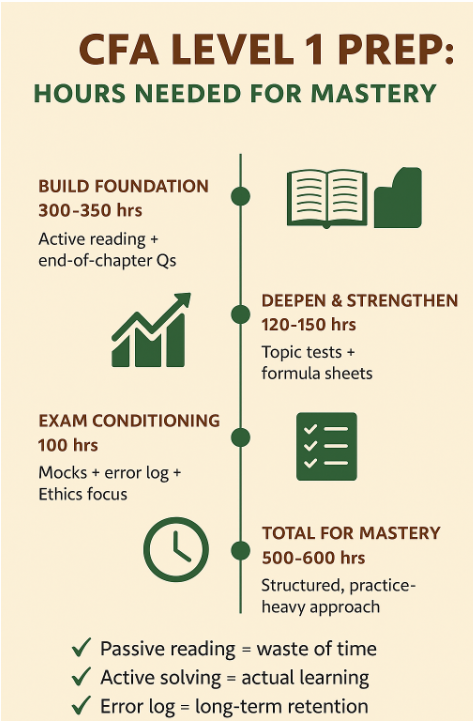
    If your goal is to build a solid foundation — not just for Level 1, but also for Level 2, Level 3, and your actual job in investment analysis or portfolio management — then aim for 500 to 600 hours.

    Why so much?
    Because CFA Level 1 is not just about cramming. It covers ethics, financial reporting, corporate finance, equity, derivatives, alternative investments, portfolio management, fixed income — and expects you to understand how these connect.

    A weak base now will haunt you in Level 2, which dives even deeper.


    ⏳ What Does a Smart Time Plan Look Like?

    Here’s a structured timeline that has worked for hundreds of my students:


    🗓️ Months 1 to 3 — Build Your Foundation (300–350 hours)

    • Read all study material actively, not just to complete pages.
    • After each reading, solve the end-of-chapter questions immediately.
    • Do topic-wise short quizzes to reinforce concepts.
    • Keep a simple error notebook from day one.
    • This is the heaviest phase — expect to invest around 25-30 hours a week if you are spreading over three months.

    🗓️ Months 4 to 5 — Strengthen & Deepen (120–150 hours)

    • Start combining readings. Revise earlier topics along with the newer ones.
    • Do more complex problem sets.
    • Build formula sheets, practice quick recall.
    • Start introducing mini mocks (half tests on multiple topics).

    🗓️ Month 6 — Exam Conditioning (100 hours)

    • Take at least 3 full mock exams, ideally spaced 10–12 days apart.
    • Analyse every wrong answer — was it a conceptual gap, silly mistake, or panic?
    • Keep revising ethics regularly. Ethics is notorious for tripping up scores.

    🚀 It is Not Just About the Hours

    Too many candidates obsess over the total hour count. The truth?
    How you use your time matters far more.

    • Passive reading means your hours mean little.
    • Active practice (solving, reviewing, retesting mistakes) means real learning.
    • Keeping an error log means you never repeat the same mistake twice.

    💡 Quick Summary

    GoalHours NeededFocus
    Just to pass250–300 hrsSkim concepts, do basic practice
    True mastery500–600 hrsThorough reading + extensive practice + mocks

    🔥 My Last Words

    Your CFA charter will stay with you for life. It will open doors and shape your reputation.

    So do not cut corners.
    Build your foundation now — your future Levels (and your career) will thank you.

    If you want, I can even send you a detailed 4- or 5-month plan with weekly targets. Just drop me a message.


    Bookmark this page and return to it as you plan your schedule.
    Remember, you are not studying just to pass an exam. You are preparing to be a professional who truly understands investments.


    ❓ FAQs: CFA Level 1 Prep Time

    How many hours should I ideally study?
    ➡ For mastery, plan 500–600 hours.
    For just scraping through, maybe 250–300, but it is risky.

    Can I clear Level 1 with 3 months of prep?
    ➡ Only if you can give 25–30 hours a week and already have a strong finance background.

    Is it okay to skip end-of-chapter questions and only do mocks later?
    ➡ No. Your foundation is built during readings + topic-wise questions. Mocks only test what you already know.

    How many mocks are enough?
    ➡ At least 3 full mocks under timed conditions.
    Analyse each thoroughly.

  • 🎯 The Best Sell-Side and Buy-Side Careers for CFA Charterholders (And Why It Depends on You)

    🎯 The Best Sell-Side and Buy-Side Careers for CFA Charterholders (And Why It Depends on You)

    Hey there, ambitious number-cruncher (or soon-to-be)!

    If you’ve earned (or are slogging through) the CFA charter, first off — hats off to you. That’s no small feat. You’ve survived a mountain of ethics case studies, tortured your brain with LIFO vs FIFO, and probably aged five years in the process.

    So now comes the million-dollar question:

    👉 What’s the best job you can land with a CFA?

    Let’s break it down — in simple, real-world, “not-just-for-LinkedIn” language.


    🚀 Wait, why does a CFA even matter?

    The CFA is more than just three letters you tack onto your LinkedIn headline.

    It signals you’re deadly serious about investment analysis, portfolio management, and not defrauding clients (seriously, ethics is half the program). Employers love it because it saves them the hassle of wondering if you can read a balance sheet.

    But here’s the kicker: the CFA doesn’t automatically decide your career. It just opens a lot more doors — whether you want to be a market wizard, a spreadsheet sleuth, or someone helping rich people sleep better at night.


    🏦 Top Sell-Side Roles for CFA Holders

    The sell-side is all about helping clients buy or sell investments. That means advising, researching, pitching ideas — then stepping back to watch someone else put skin in the game.

    Some of the juiciest CFA-friendly roles here:

    🌟 Equity Research Analyst:
    Dive deep into companies, build sophisticated models, write research that moves markets (or at least gets a shoutout on CNBC). If you love piecing together stories from financial statements, this is your jam.

    🌟 Fixed Income Research Analyst:
    Bonds, baby. Less hype than stocks, but arguably more important. You’ll evaluate credit risks, macro trends, and interest rate movements.

    🌟 Sales & Trading:
    Fast-paced, adrenaline-heavy. While the CFA isn’t mandatory here, it gives you serious street cred, especially with institutional clients who trust you more when you can fluently talk duration convexity without blinking.

    🌟 (Some) Investment Banking roles:
    Think M&A valuation teams or capital markets. Though MBAs still dominate, a CFA helps you stand out, especially in technical valuation discussions.


    💰 Top Buy-Side Roles for CFA Holders

    The buy-side is where you actually manage money. This is where all that fancy research translates into “let’s put our capital here.”

    Perfect playground for a CFA.

    🌱 Portfolio Manager (or future PM):
    Make decisions on what to buy, hold, or sell — across stocks, bonds, alternatives. Also handle client meetings where you justify your brilliance.

    🌱 Buy-Side Analyst:
    The PM’s right hand. Pitch ideas, defend them, track positions, build your own niche expertise.

    🌱 Credit Analyst / Fixed Income Specialist:
    Pension funds, insurance companies, asset managers love CFAs in this space. Analyze who might default (before they do), and how to best structure debt portfolios.

    🌱 Private Wealth Management:
    Not just for yacht parties and family trusts (though there’s some of that). You help high-net-worth individuals meet goals — like buying a vineyard or sending kids to Harvard. CFA tells them you know your stuff.

    🌱 Alternative Investments:
    Hedge funds and private equity especially value the CFA for due diligence, portfolio construction, and risk management. That said, they also care hugely about networking and deal flow, so keep building your circle.


    🎨 So… what’s actually best?

    Here’s the truth no one puts on a brochure:

    👉 It depends on who you are.

    ✅ Love telling stories with numbers and writing reports that might get picked up by Bloomberg? Equity research.
    ✅ Crave the rush of rapid trades and market volatility? Sales & trading.
    ✅ Want to build long-term strategies, analyze macro trends, and literally grow people’s money? Portfolio management.
    ✅ Enjoy helping individuals secure their family’s future or structure their philanthropic dreams? Private wealth.


    🔥 Quick Tips to Figure It Out

    1. Talk to people already doing these jobs. Coffee chats beat job descriptions.
    2. Try a side project: Build a mock portfolio, publish investment blogs, take a short online specialization.
    3. Upskill strategically. Platforms like Coursera, Udemy, MidhaFin etc. have affordable investment & alternative asset courses that mesh well with CFA knowledge (some even free). 

    🎉 The Bottom Line

    A CFA doesn’t lock you into one track — it gives you a sturdy launchpad. Whether you’re steering billion-dollar mutual funds, dissecting corporate earnings, or advising a tech billionaire, the right path is the one that makes you excited to open your laptop on Monday.

  • Last 60 Days Before CFA Level 1: Smart Strategies for Final Prep & Revision

    Last 60 Days Before CFA Level 1: Smart Strategies for Final Prep & Revision

    You are in a good position. You do not need to go through every reading again.
    Instead, these last two months should be dedicated to intense practice, concept reinforcement, and exam-style thinking.

    Here is how you should ideally allocate your time:

    • 🔸 70% of your time: Focus on solving questions – start with topic-wise question sets and gradually move to full-length mock exams.
    • 🔸 30% of your time: Use this for revising important formulas, reviewing concept summaries, and going through your error log (if you have been maintaining one).

    This phase is not about covering more material – it is about solidifying what you have already studied and training yourself to perform under exam conditions.


    If You Are Starting From Scratch

    You might have seen some forum posts claiming that 250 to 300 hours are enough to pass CFA Level 1.

    But you need to ask yourself –
    Do I want to just barely pass (with no guarantee) or actually understand and master the concepts?

    That is the difference between just surviving the exam and truly learning finance.

    💡 This is why I strongly recommend 500 to 600 hours of preparation for each level of CFA.
    It is not just about the exam – it is about building the foundation of your professional credibility and confidence.

    If you are starting now with just two months in hand, the journey will be extremely challenging. You will need a very structured study plan, 6 to 8 hours daily, and zero distractions – and even then, it might be risky.


    What Your Final 2 Months Should Look Like

    Whether you are in a good position or playing catch-up, your final 60 days should be structured around these priorities:

    1. Take at least 3 full mock exams

    Start around 5 to 6 weeks before the exam. Space them out so you have time to review mistakes and plug concept gaps.

    2. Create and stick to an error log

    Note down every mistake you make, especially in practice questions. Track whether the issue was conceptual, silly, or due to pressure.

    3. Revise formulas and Ethics weekly

    Some parts of the curriculum (especially Ethics) require continuous revisiting. Make it a weekly ritual – even if for 1–2 hours.

    4. Keep the intensity high

    The last stretch is all about momentum. This is not the time to relax or spread out your effort. Focused, time-boxed study sessions will help you retain more and build exam-day endurance.


    Final Words

    The CFA exam is not just a test of knowledge – it is a test of discipline, consistency, and decision-making under pressure.

    Two months can be enough – but only if you use them wisely. Whether you are polishing what you have already learned or pushing through a massive catch-up, remember: the effort you put in now will echo through your career.

  •  Is a CFA Still Worth It in 2025? A Balanced Perspective

     Is a CFA Still Worth It in 2025? A Balanced Perspective

    The Chartered Financial Analyst (CFA) credential has traditionally been the gold standard of finance and investment management. But with the changing face of finance and the increasing importance of technology and non-traditional credentials, many candidates wonder if it’s still worth the time, money, and effort to pursue the CFA in 2025. Here’s a balanced analysis of the advantages and disadvantages:

    Benefits of the CFA in 2025

    1. Global Reputation and Recognition
    • CFA continues to be one of the most highly respected designations worldwide in the finance sector. It reflects a superior level of proficiency in investment analysis, portfolio management, and ethical practice.
    • Relevance: Since global financial institutions continue to value the rigorous and methodical curriculum that CFA professionals study and then pass the 3 levels of the CFA exams, this reputation is unlikely to deteriorate.
    1. Curriculum Updates Aligned with Industry Trends
    • The CFA Institute has consistently updated its curriculum to reflect the latest developments in the finance industry.
    • Recent Additions: New content on artificial intelligence, machine learning, blockchain, and ESG (Environmental, Social, and Governance) investing has been integrated to ensure that candidates remain well-equipped for the rapidly evolving financial world.
    • Modular Learning Options: Starting in 2024, the CFA Institute introduced specialized electives in areas like private markets, financial technology (FinTech), and data science, allowing candidates to tailor their learning paths to their career goals.
    1. Career Progress and Expertise
    • Many financial institutions prefer or even require CFA charterholders for roles such as portfolio manager, equity analyst, risk manager, and investment banker.
    • Emerging Fields: As FinTech, ESG investing, and alternative assets become more important, CFA holders with specialized knowledge can stay relevant.
    1. Higher Earning Potential
    • CFA charterholders, on average, earn 20–25% more than their non-CFA counterparts, depending on their role and experience.
    • Post-COVID Finance Boom: As more investments are made in technology, sustainable finance, and international markets, finance professionals with established analytical abilities will remain in demand.
    1. Solid Ethical Base
    • With increased scrutiny of ethical behavior and rules, the CFA curriculum’s focus on ethics and professional standards makes charterholders stand out in terms of credibility and decision-making.

    Challenges and Considerations

    1. Time and Effort Required
    • Passing all three levels of the CFA exam may require anywhere between 2 to 4 years, with a suggested study time of more than 500 hours per level.
    • Opportunity Cost: Several professionals choose other credentials or niche certifications that are less time-consuming, including the Financial Risk Manager (FRM), Chartered Alternative Investment Analyst (CAIA), or MBA with a finance concentration.
    1. Limited Relevance for Certain Roles
    • Though the CFA is priceless when it comes to investment research and portfolio management, it might not give a direct edge in fields like venture capital, technology-driven finance positions, private equity, or corporate finance.
    • Tech Disruption: With the transformation of finance through AI and data analytics, tech-oriented skills (e.g., machine learning, Python, R) could be more valuable in some industries than a classical CFA.
    1. Increased Competition and Market Saturation
    • The number of CFA charterholders has increased steadily over time, which might soften the perception of exclusivity and competitive advantage that the credential used to hold.
    • New Credentials: Credentials such as the CFA Certificate in ESG Investing and other specialist credentials are emerging to prominence, which could soften the CFA’s broad applicability.
    1. Cost Considerations
    • The overall cost of obtaining a CFA (exam fees, study materials, and possible retakes) may exceed $3,000–$4,000.
    • ROI Question: Depending on professional path, it can take a few years to pay back the investment, and that deters some professionals.

     Trends to Watch in the Future

    1. Integration of AI and FinTech

    As finance becomes more data-driven, candidates with a combination of CFA expertise and technical skills (such as quantitative finance, Python, and machine learning) will be at an advantage.

    1. Increasing Demand for ESG and Sustainable Investing

    The greater emphasis on ESG standards by the CFA Institute makes the designation appropriate for those seeking expertise in sustainable finance.

    1. Emergence of Micro-Credentials and Remote Learning

    As employers prefer niche skill sets to general knowledge, micro-certifications from online players such as Coursera, edX, and niche courses (such as Google’s Data Analytics Certificate) are picking up pace.

    Is It Worth It? Final Verdict

    ✅ Worth It: If you’re targeting asset management, wealth management, or equity research roles, or want to work in international financial centers, the CFA remains a worthwhile credential that can lead to opportunities.

    ❗️ Consider Alternatives: If you’re looking at private equity, FinTech, or data finance roles, other qualifications or technical certifications may provide greater ROI and career mobility.

    The CFA in 2025 is no longer a “one-catch-all” for every career but still very applicable for some careers. Take good care to analyze your career ambitions, the level of time involvement, and changing finance industry needs before making your choice.

  • CFA vs MBA(Finance)- Key differentiator (Crucial factors)

    CFA vs MBA(Finance)- Key differentiator (Crucial factors)

    Introduction 

    A CFA designation is highly specialized and focuses on investment management and analysis. It is well-regarded in the finance industry and can be particularly beneficial for those looking to pursue careers in portfolio management, equity research, or asset management.

    On the other hand, an MBA with a concentration in finance offers a broader business education with a focus on finance. It can be beneficial for individuals seeking roles in corporate finance, investment banking, or financial consulting. An MBA also provides a wider range of business skills and knowledge beyond finance.

    Ultimately, the decision should be based on the candidate’s career aspirations and the specific skills and knowledge he/she wishes to acquire. Some individuals may even choose to pursue both qualifications at different points in their careers to complement their skill sets. 

    In this article, we will discuss the key differences or crucial factors to consider when one is choosing between the two top-notch designations. 

    Key Differentiating factors 

    Specialization vs. Broad Business Education: 

    The CFA program is highly specialized and focuses primarily on investment management and analysis. It provides a deep understanding of financial markets, securities, and portfolio management techniques.

    An MBA with a finance focus offers a broader business education that covers various disciplines such as marketing, operations, strategy, leadership, and entrepreneurship. While it includes finance-related courses, it also provides a comprehensive understanding of overall business functions.    

    Depth vs. Breadth of Knowledge: 

    The CFA program goes into great depth on topics specifically related to finance and investment. It covers a wide range of subjects but delves deeply into each, ensuring a thorough understanding of investment theory, valuation techniques, and portfolio management strategies. 

    An MBA with a finance focus offers a broader perspective by combining finance courses with other business disciplines. While it provides a solid foundation in finance, it also covers a wider range of subjects, allowing students to understand the interplay between finance and other business functions. 

    Exam-based vs. Coursework-based 

    The CFA program is exam-based, requiring candidates to pass three levels of comprehensive exams. The exams are known for their rigor and require significant preparation and study time. 

    An MBA program with a finance focus typically relies on coursework, assignments, and projects. While exams may be present, the emphasis is often on practical application through case studies, group projects, and experiential learning. 

    Global Recognition: 

    The CFA designation is globally recognized and highly regarded in the finance industry. It is considered a mark of expertise in investment management and analysis and is valued by employers worldwide.

    An MBA with a finance focus, especially from a reputable business school, also carries prestige and recognition. However, the reputation and recognition may vary depending on the specific program and the school’s overall reputation.

    Work Experience Requirement: 

    To earn the CFA charter, candidates must have at least four years of relevant work experience in the investment industry. This requirement ensures that candidates have the practical experience to complement their theoretical knowledge.

    An MBA program typically does not have a specific work experience requirement, although many students enter MBA programs with some prior work experience. The emphasis is on combining academic learning with real-world experience gained through internships, projects, and networking opportunities. 

    Career Focus and Flexibility: 

    The CFA designation is particularly beneficial for individuals seeking specialized finance roles, such as investment management, equity research, or asset valuation. It is highly regarded in the investment industry and can provide a competitive advantage in these specific areas.

    An MBA with a finance focus offers greater career flexibility, allowing graduates to pursue a wide range of finance-related roles, including corporate finance, investment banking, financial consulting, and entrepreneurship. A broader business education can be advantageous for leadership positions that require a holistic understanding of business operations. 

    Time and Duration: 

    The CFA program typically takes a minimum of three years to complete, as it consists of three levels of exams that are offered annually. Candidates often devote significant study time outside of their regular work hours to prepare for each level.

    An MBA program with a finance focus usually takes two years of full-time study, although there are also part-time and executive MBA programs available. The program duration allows for a more comprehensive and immersive learning experience. 

    Learning Approach: 

    The CFA program is self-study focused, with candidates using CFA Institute’s curriculum and study materials to prepare for the exams. Candidates often rely on a combination of textbooks, online resources, and practice questions to supplement their learning.

    An MBA program offers a structured learning environment with a mix of classroom lectures, case discussions, group projects, and experiential learning opportunities. Students engage with faculty and fellow classmates, fostering a collaborative learning environment. 

    Continuing Education and Professional Development 

    The CFA designation requires CFA charterholders to adhere to a code of ethics and participate in ongoing professional development. This includes completing a certain number of continuing education credits each year to maintain the charter.

    An MBA degree is a one-time qualification, although many MBA graduates continue to engage in professional development opportunities throughout their careers. This can include attending workshops, conferences, or pursuing additional certifications to enhance their knowledge and skill. \

    Geographical Considerations 

    The CFA designation is globally recognized and can be beneficial for professionals seeking opportunities in different countries or regions. The curriculum and knowledge gained through the program are applicable across various financial markets worldwide.

    An MBA degree, especially from a renowned business school, can also carry international recognition and may provide networking opportunities specific to the region where the school is located. Regional factors may influence the reputation and network associated with an MBA program.

    Conclusion 

    In summary, the CFA designation offers specialized knowledge in investment management and analysis, with a strong global reputation in the finance industry. On the other hand, an MBA with a finance focus provides a broader business education that encompasses various disciplines, networking opportunities, and the potential for career switching.

     It’s essential to assess your circumstances, career goals, and preferred learning style when choosing between a CFA designation and an MBA with a focus on finance. Consider factors such as your desired level of specialization, time commitment, cost, learning approach, and long-term career aspirations. 

    You may find it helpful to speak with professionals who have pursued each path or reach out to relevant industry associations or academic institutions to gather more insights.