Tag: CFA time management

  • Mock Review Playbook

    Mock Review Playbook

    Introduction

    A mock exam often feels like a judgment on your preparation. You look at the total score, compare it with your expectations, and the anxiety sets in. The truth is different. A mock exam is a diagnostic. It shows how you think under pressure. It shows what you truly understand and what needs reinforcement. When you review a mock the right way, the score becomes the least important part of the process.

    Unfortunately, many CFA candidates rush from one mock to the next without a structured review. They hope repetition will lift their scores, yet the same errors appear again. This results in stress, overconfidence in some areas, and blind spots in others.

    This playbook gives you a practical routine to review any CFA Level 1 mock. You will learn how to identify patterns, classify your errors, and create a targeted revision plan that actually sticks. Think of this as an operating manual for mock exams. Follow it consistently and you will feel more confident, more organised, and more prepared for exam day.


    Mindset First: Score Last, Learning First

    When you finish a mock, the instinct is to check the total. Resist that urge. Your score is only a snapshot of one attempt. It does not say anything about your potential. Note it once for reference, then put it aside.

    Your real goal is to understand your decisions. Why did you select a particular option. What were you thinking. Where did the reasoning break. What steps were rushed. When you review your thinking rather than only the outcome, you develop exam discipline. This is what separates candidates who improve from candidates who stagnate.

    Tell yourself this before every mock review:
    The score comes last. The learning comes first.


    Phase 1. Set Up a Proper Review Session

    Treat your review with the same respect as the mock.

    Create a quiet window

    Give yourself two to three hours on the same day or the next morning. Reviewing while the thought process is still fresh helps you understand what you attempted to do, not only what you got right or wrong.

    Gather your tools

    You will need:

    • Your marked mock exam.
    • Official explanations.
    • A simple tracker. Notebook or spreadsheet.
    • Your formula sheet or summary notes.

    Keep everything in one place. A clean setup prevents distractions.

    Define what you want to achieve

    Every review should produce three outputs.

    1. A topic heat map.
    2. An error classification table.
    3. A seven day revision plan.

    When you review with a clear purpose, you stay focused and finish with actions instead of confusion.


    Phase 2. Build a Topic Heat Map

    Before you zoom in on individual questions, start with a top down picture.

    Tag your mistakes

    Go through your mock and label every wrong question by topic.
    FRA. Inventory.
    Fixed Income. Term structure.
    Quant. Sampling.
    Equity. Dividend discounts.

    Be specific. This helps you find patterns.

    Add a short reason tag

    Next to each wrong question, add a short code.

    • Concept gap.
    • Calculation slip.
    • Misread.
    • Time pressure.
    • Guess.
    • Procedure error.

    Do not overthink. Just label what feels correct.

    Summarise the pattern

    Now group your accuracy by sections. Ethics. Quant. Economics. FRA. Equity. Fixed Income. Corporate Issuers. Derivatives. Alternatives. Portfolio Management.

    Create a table with two numbers for each section.
    Total attempted.
    Total correct.

    You will often notice that two or three areas account for most of your lost marks. These are your immediate targets for the coming week.

    This heat map prevents random studying and keeps your focus sharp.


    Phase 3. Build an Error Taxonomy That Works

    Not all mistakes need the same fix. Your review becomes powerful when you understand the type of error you made.

    Common mistake types and how to fix them

    Concept gap

    You do not know or do not recall the underlying idea.
    Fix: Reread only the relevant section. Keep it short. Then solve ten to fifteen targeted questions.

    Framework confusion

    You know the pieces but cannot connect them.
    Fix: Rebuild the structure. Write a decision tree or short summary in your own words.

    Procedure error

    You understood the concept but executed steps incorrectly.
    Fix: Create a three to five step checklist and rehearse it before new questions.

    Formula slip

    Idea is right. Calculation is wrong.
    Fix: Annotate the formula with units and common traps. Then practise slowly with unit checks.

    Reading misinterpretation

    You missed a keyword or detail.
    Fix: Train yourself to underline qualifiers. Annual, nominal, pre tax, post tax, before adjustments, after adjustments.

    Time management miss

    You spent too long on one difficult question.
    Fix: Use strict cutoffs. If you cross ninety seconds without a plan, flag and move on.

    Blind guess

    Either you ran out of time or had not studied the topic.
    Fix: Decide whether it falls within this weeks scope. Not all gaps need immediate fixing.

    Over two or three mocks, you will notice patterns. Maybe you misread often. Maybe formulas. Maybe concept clarity. Your taxonomy directs your revision.


    Phase 4. Deep Dive the Top Three Problem Areas

    Do not try to fix everything. It spreads your attention too thin. Pick the three highest impact areas from your heat map and go deep.

    Step 1. Relearn with purpose

    Focus on the exact node where your understanding failed. If you missed questions on leases, focus on measurement and impact. Do not reread the entire FRA book.

    Step 2. Create a one page note

    Write the rules and relationships in your own words. One page only. If it cannot fit on a single page, it is not distilled enough.

    Step 3. Run a deliberate practice set

    Solve ten to twenty questions on that node. Check your result. If accuracy is below eighty percent, repeat with a new set.

    Step 4. Build a trap list

    Note phrasing, numbers, or patterns that trick you. Every subject has traps. Once you know them, your accuracy jumps.

    This focused cycle saves time and drives retention.


    Phase 5. Post Mock Reinforcement Routine

    Your brain forgets what it does not revisit. Use a simple reinforcement window.

    Within 24 hours

    Redo every question you got wrong without looking at explanations. If you still miss it, mark it in red. This makes the concept memorable.

    Within 3 days

    Attempt ten fresh questions in your weak topics. Keep the sets short.

    Within 7 days

    Take a mixed thirty to forty five minute quiz that includes your trap topics. Aim for eighty percent or higher.

    This rhythm keeps your understanding active and prevents forgetting during the long preparation cycle.


    Smart Strategy for Taking Mocks

    Review matters, but how you take mocks also affects performance.

    Two pass technique

    On the first pass, harvest the clean points. Skip anything that feels long or unclear.
    On the second pass, return to flagged questions and think more deeply.

    This prevents time traps and builds confidence.

    Choose a section order and stick to it

    Some candidates start with Ethics for calm reading. Others start with their strongest section to gain early momentum. Choose what suits your mind and use the same plan for all mocks. Consistency builds rhythm.

    Micro cutoffs

    You have roughly ninety seconds per question on average. Do not exceed that on the first pass. When your timer crosses ninety seconds and you still have no plan, move on.

    Simulate exam conditions

    Use the same calculator. Same water bottle. Same scratchpad style. Same break pattern. Reduce surprises on exam day.


    Turning the Review into a Weekly Plan

    When the review is complete, write a one page plan with three parts.

    Wins

    What went well. What improved. Celebrate small progress.

    Fixes

    Top three issues with a clear remedy.
    Example. FRA. Deferred tax recognition rules. Ten targeted questions on Wednesday.

    Rules for the next mock

    Two behaviour rules you will follow.
    For example. Underline compounding frequency. Move on at ninety seconds.

    Pin this one page plan near your study desk. This keeps you honest and consistent.


    How Many Mocks Should You Take

    There is no magic number. What matters is depth of review, not quantity.
    For most Level 1 candidates, five to seven full mocks with proper review is more than enough.

    If you begin late, do three to four mocks but review every one with precision. Improvement comes from reflection, not repetition.


    Final Takeaway

    A mock exam is not a verdict on your readiness. It is a spotlight that reveals how you think under pressure. The review is where learning happens. Build a heat map. Classify your errors. Fix three areas at a time. Reinforce within a week. Refine your exam behaviour. Repeat.

    Do this consistently and your scores will rise. More importantly, your decision quality will mature. That is what passes the CFA exam.

  • Do I Need a Finance Background for pursuing CFA ?

    Do I Need a Finance Background for pursuing CFA ?

    Introduction

    Every year, thousands of candidates from engineering, economics, mathematics, and even the arts begin their CFA journey. Many share the same concern: Can I do this if I don’t have a finance background?

    It is a fair question. The CFA curriculum looks intimidating at first glance. Terms like “equity valuation,” “portfolio optimization,” or “derivative pricing” can sound foreign to someone outside finance. Yet the truth is simple. A finance degree helps, but it is not a requirement. What matters most is your ability to learn systematically, think analytically, and stay consistent.

    The CFA program is designed for a global audience. It assumes that not every candidate starts with formal finance education. The curriculum builds your knowledge layer by layer, from the basics of money and time value to advanced portfolio management.

    Let’s unpack what that really means in practice.


    Understanding the CFA Curriculum

    The CFA Institute structures the curriculum around three progressive levels. Each level deepens your understanding but begins with clear, defined fundamentals.

    Level I – Building the Foundation

    Level I introduces you to the language of finance. You learn how markets work, what financial statements show, and how analysts interpret them.

    Key subjects include:

    • Quantitative Methods: Basic statistics, probability, and time value of money.
    • Financial Reporting and Analysis: Understanding income statements, balance sheets, and cash flow.
    • Ethics and Professional Standards: The backbone of the CFA program.
    • Economics and Corporate Finance: Core principles applied to investment decisions.

    A non-finance candidate can learn these with discipline and the right resources. Nothing here requires prior accounting or trading experience. You just need to approach each topic as a structured problem, not as jargon to memorize.

    Level II and III – Application and Integration

    Level II moves into valuation, asset classes, and analytical techniques. Level III focuses on portfolio management and client strategies.

    By the time you reach these levels, you will already have enough context to connect the dots. The progression feels natural if your foundations are clear. This design is intentional — the CFA Institute wants candidates from diverse academic backgrounds to succeed.


    The Real Prerequisites: Curiosity and Consistency

    What truly predicts success is not a finance degree. It is the willingness to learn consistently over time.

    • Curiosity helps you question why a concept matters. When you study risk-adjusted returns, do not stop at the formula. Ask what it means in a real portfolio.
    • Consistency keeps you on track. The CFA program rewards steady progress more than bursts of last-minute effort.

    Most successful candidates treat CFA preparation like a long-term project. They plan 250–300 study hours per level, review regularly, and practice actively. This discipline levels the field between finance and non-finance backgrounds.


    What to Expect If You Are Not from Finance

    You will likely face three early challenges.

    1. Unfamiliar Terminology

    Words like “yield curve,” “accruals,” or “beta” may appear confusing. Do not rush through them. Build a quick glossary as you study. Once you use these terms in examples and practice questions, they will stick naturally.

    2. Accounting Concepts

    Many candidates find accounting to be the toughest subject initially. Focus on the logic rather than the format. Learn how transactions flow through financial statements. If possible, watch short explainer videos or attend structured sessions that connect accounting to business reality.

    3. Quantitative Methods

    The math is not advanced, but it requires attention to detail. You will deal with statistics, discounting, and probability. Use spreadsheets to practice calculations and visualise what formulas do. Once you see how the numbers behave, the fear of formulas fades.


    How to Bridge the Knowledge Gap

    Here are some practical steps to build comfort quickly.

    1. Start Early with the Basics
      Spend the first few weeks understanding financial statements and time value of money. These two topics are used everywhere in the CFA curriculum.
    2. Use the Right Study Order
      If you are a beginner, do not start with Derivatives or Fixed Income. Begin with Ethics, Quantitative Methods, and Financial Reporting. That sequence builds a strong foundation.
    3. Focus on Understanding, Not Memorization
      Ask “why” behind every formula. For instance, why does compounding matter? Why is discount rate linked to risk? This habit converts facts into intuition.
    4. Join a Study Group or Mentorship Program
      Interaction speeds up learning. When you explain a topic to others, you identify your own gaps. MidhaFin’s study groups and doubt-clearing sessions are excellent for this.
    5. Regularly Practice Questions
      Conceptual clarity grows through application. After every topic, solve 15-20 questions. Review explanations carefully. The CFA exam rewards reasoning, not memorized answers.
    6. Link Finance to Real-World News
      Read market summaries or company reports occasionally. You will begin to connect theory to practice, which is the essence of becoming a finance professional.

    How Candidates from Non-Finance Backgrounds Perform

    Interestingly, the CFA Institute’s own data shows that many successful candidates come from non-finance backgrounds, particularly engineering and economics.

    Why? Because analytical thinking and problem-solving matter more than prior subject exposure. Engineers, mathematicians, and statisticians often find the quantitative parts intuitive. Those from commerce or business degrees may grasp accounting faster. Each background has strengths.

    The CFA program equalises the rest. Over time, everyone builds a balanced understanding across ethics, economics, analysis, and portfolio management.


    The Value of a Non-Finance Perspective

    There is also an advantage to entering CFA without formal finance education. You approach topics with fresh logic instead of assumptions.

    For instance:

    • An engineer studying portfolio optimization sees it as a systems problem of risk and return.
    • An economist views market cycles through data relationships.
    • A computer science graduate may see quantitative finance as an extension of algorithms.

    These diverse approaches enrich your understanding. Modern finance values multidisciplinary thinking, which includes the ability to apply logic, statistics, and technology together.


    What You Gain from the CFA Journey

    Regardless of your background, the CFA program builds the same core skill set:

    • Ethical and professional reasoning.
    • Financial analysis and interpretation.
    • Understanding of global investment markets.
    • Ability to communicate financial insight clearly.

    These are transferable skills. Whether you become a portfolio analyst, risk manager, consultant, or entrepreneur, this foundation adds credibility and structure to your decision-making.


    Final Takeaway

    You do not need a finance background to pursue the CFA charter. You need persistence, curiosity, and a clear study plan.

    Think of the CFA journey as a bridge from where you are to where you want to be. The early steps may feel steep, but every topic builds on the last. Within months, you start thinking like an analyst. The transformation from learning terms to applying logic makes the CFA experience truly rewarding.

    Stay patient, stay structured, and stay curious. The finance background can wait. The mindset cannot.

  • Making Sense of CFA Level 1 Pre-Readings: What You Should Actually Do

    Making Sense of CFA Level 1 Pre-Readings: What You Should Actually Do

    Preparing for the CFA Level 1 exam often comes with a question that confuses many students:

    Should you study the pre-readings that appear before the main curriculum? 

    These short readings are meant to introduce key ideas in Economics, Quantitative Methods, and Financial Statement Analysis.

    Let us understand what they really mean, why they exist, and how to deal with them in a practical way.


    Understanding the Purpose of Pre-Readings

    The CFA Institute has recently reorganized the Level 1 syllabus to make it more efficient. Some of the older introductory lessons have been separated from the main modules and placed in a section called pre-readings.

    Their goal is simple: to prepare candidates with the basic knowledge required before starting the core material.

    The pre-readings include the following::

    • Quantitative Methods: Basic statistics, probability, and numerical tools
    • Economics: Key ideas in microeconomics and macroeconomics
    • Financial Statement Analysis: Structure and meaning of income statements, balance sheets, and cash flow statements

    These topics act as the entry gate to the larger curriculum. But the real question is:  

    Should you spend time reading them all?


    Are Pre-Readings Worth Your Time?

    The CFA Institute suggests that most candidates are already familiar with the material. That might be true for some, but not for everyone.

    If you have been away from academics for a few years, or if your degree was not in finance, some of these ideas might not feel as fresh. Going straight into the main syllabus without revisiting them can make the learning curve steeper.

    So, even if the pre-readings are not directly tested, they still influence how well you understand what follows. Think of them as the foundation on which the entire Level 1 syllabus stands.


    How to Approach Them Without Wasting Time

    Not every candidate needs to go through every page. What works better is a filtered, topic-by-topic review.

    Here is a structured plan:

    1. Get a quick overview.
      Read the chapter introductions and sub-headings to understand what each section covers.
    2. Mark your comfort zones.
      Identify areas that look familiar. For example, if you have used accounting statements regularly, you might not need to study all of FSA in detail.
    3. Focus on weak points.
      Spend time only on parts that seem unfamiliar or unclear. This selective study method helps you save time while reinforcing areas that matter.

    If you have ample time before the exam, you can dedicate around two weeks per section. If you are on a tighter timeline, a few focused study sessions per area will still be effective.


    Key Areas That Deserve Extra Attention

    Some topics in the pre-readings create the base for many later chapters. You can use the following checklist to stay focused:

    • Quantitative Methods: Concentrate on descriptive statistics, measures of dispersion, and probability. These ideas return again in regression, correlation, and risk analysis.
    • Economics: Refresh your understanding of demand and supply, market types, inflation, and economic growth indicators.
    • Financial Statement Analysis: Ensure you can interpret how the three financial statements connect. Knowing how numbers move between income, cash flow, and balance sheets saves time later.

    The MidhaFin View: Study Smart, Not Twice

    At MidhaFin, we strongly believe that you do not need to study everything twice. If a topic covered in the pre-readings appears again later in the curriculum, and is explained there in full, then you can safely cover it once, in detail, during the main study.

    This approach forms the base of how we design our study material and video lessons. Our goal is not to overload students with repetitive theory but to guide them through a logical sequence of learning.

    For example, if Financial Ratios are introduced briefly in the pre-readings and then taught extensively in the FSA section, it is more efficient to learn them properly when you reach that chapter. By doing so, you spend your effort where it adds the most value instead of revisiting the same ideas multiple times.

    This mindset not only saves time but also builds stronger conceptual links between topics. In CFA preparation, efficiency is just as important as effort.


    Why a Strong Foundation Still Matters

    Even though pre-readings are not tested directly, they shape how smoothly you move through the rest of the material. Students who skip them entirely often need to pause later to fill in missing basics, which breaks study flow.

    Instead, treat them as a warm-up round. Review them quickly, fill knowledge gaps, and then move to the core chapters with confidence. Remember that CFA Level 1 is not about memorizing every line; it is about understanding how financial concepts connect.


    A Balanced Strategy for Success

    Here is a simple rule:

    • If a concept is completely new to you, study it now.
    • If you already know it, just refresh it briefly.
    • If it will be covered again in depth later, combine the learning and handle it once.

    This three-step thinking helps you stay efficient without missing key knowledge.

    In our MidhaFin learning framework, this balance is built into the study plan. Every topic connects to the next in a natural order so that you keep moving forward without confusion or overlap.


    Closing Thoughts

    Pre-readings might look like optional reading material, but they play an important role in shaping your confidence for the CFA Level 1 exam. They ensure that when you reach complex parts of the syllabus, you do not get stuck on concepts that should have been clear earlier.

    Treat them as the foundation, not as an extra burden. Study them with purpose, connect them with your main lessons, and always think about how each topic fits into the bigger picture of finance and investment analysis.

  • How Much Time Do You Really Need to Prepare for CFA Level 1?

    How Much Time Do You Really Need to Prepare for CFA Level 1?

    If you are starting your CFA Level 1 journey, one of the first questions you will ask is —
    “How many hours do I actually need to prepare?”

    You might have seen people on forums quoting numbers like 250 to 300 hours, saying it is enough to clear Level 1.

    While that might be true for some, the reality is more layered. The right amount of time truly depends on:

    Your background – Are you from finance, accounting, or completely new to these subjects?
    Your goals – Are you aiming to simply scrape through or genuinely master the concepts?
    Your seriousness & discipline – Are you consistent, or will you squeeze studies only on weekends?


    🏗️ The Two Types of CFA Aspirants

    🎯 1. The “Just to Pass” Group

    This group usually targets 250 to 300 hours.
    It works if you already have a strong grasp of financial statements, quant, and economics. Many people with BCom, CA, or finance-heavy MBAs fall into this category.

    But be clear — this approach comes with trade-offs.
    It means you will focus only on what is needed to get over the line, without truly internalizing the concepts.

    And even then, it is not guaranteed. CFA exams are designed to surprise you, especially if your understanding is shallow.


    🏆 2. The “Mastery” Group (which I always recommend)

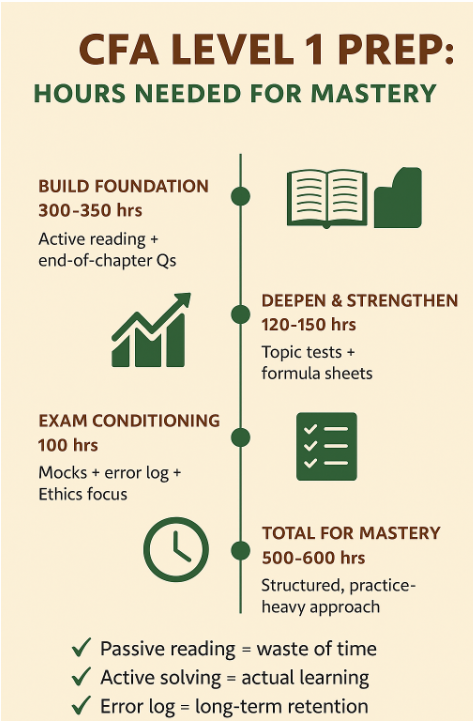
    If your goal is to build a solid foundation — not just for Level 1, but also for Level 2, Level 3, and your actual job in investment analysis or portfolio management — then aim for 500 to 600 hours.

    Why so much?
    Because CFA Level 1 is not just about cramming. It covers ethics, financial reporting, corporate finance, equity, derivatives, alternative investments, portfolio management, fixed income — and expects you to understand how these connect.

    A weak base now will haunt you in Level 2, which dives even deeper.


    ⏳ What Does a Smart Time Plan Look Like?

    Here’s a structured timeline that has worked for hundreds of my students:


    🗓️ Months 1 to 3 — Build Your Foundation (300–350 hours)

    • Read all study material actively, not just to complete pages.
    • After each reading, solve the end-of-chapter questions immediately.
    • Do topic-wise short quizzes to reinforce concepts.
    • Keep a simple error notebook from day one.
    • This is the heaviest phase — expect to invest around 25-30 hours a week if you are spreading over three months.

    🗓️ Months 4 to 5 — Strengthen & Deepen (120–150 hours)

    • Start combining readings. Revise earlier topics along with the newer ones.
    • Do more complex problem sets.
    • Build formula sheets, practice quick recall.
    • Start introducing mini mocks (half tests on multiple topics).

    🗓️ Month 6 — Exam Conditioning (100 hours)

    • Take at least 3 full mock exams, ideally spaced 10–12 days apart.
    • Analyse every wrong answer — was it a conceptual gap, silly mistake, or panic?
    • Keep revising ethics regularly. Ethics is notorious for tripping up scores.

    🚀 It is Not Just About the Hours

    Too many candidates obsess over the total hour count. The truth?
    How you use your time matters far more.

    • Passive reading means your hours mean little.
    • Active practice (solving, reviewing, retesting mistakes) means real learning.
    • Keeping an error log means you never repeat the same mistake twice.

    💡 Quick Summary

    GoalHours NeededFocus
    Just to pass250–300 hrsSkim concepts, do basic practice
    True mastery500–600 hrsThorough reading + extensive practice + mocks

    🔥 My Last Words

    Your CFA charter will stay with you for life. It will open doors and shape your reputation.

    So do not cut corners.
    Build your foundation now — your future Levels (and your career) will thank you.

    If you want, I can even send you a detailed 4- or 5-month plan with weekly targets. Just drop me a message.


    Bookmark this page and return to it as you plan your schedule.
    Remember, you are not studying just to pass an exam. You are preparing to be a professional who truly understands investments.


    ❓ FAQs: CFA Level 1 Prep Time

    How many hours should I ideally study?
    ➡ For mastery, plan 500–600 hours.
    For just scraping through, maybe 250–300, but it is risky.

    Can I clear Level 1 with 3 months of prep?
    ➡ Only if you can give 25–30 hours a week and already have a strong finance background.

    Is it okay to skip end-of-chapter questions and only do mocks later?
    ➡ No. Your foundation is built during readings + topic-wise questions. Mocks only test what you already know.

    How many mocks are enough?
    ➡ At least 3 full mocks under timed conditions.
    Analyse each thoroughly.